Buying Guides
Why Rigid Packaging Can Cost More in Air Freight Than Production (And How Collapsible Designs Save Thousands)
How volumetric weight pricing turns assembled rigid boxes into a multi-thousand-euro air freight trap, and why collapsible box engineering protects emerging brand margins.
When emerging lifestyle, jewelry, and fashion brands design their first custom packaging suite, creative focus naturally centers on unboxing elegance: rich paper textures, crisp hot-foil stamping, and bespoke hardware accents.
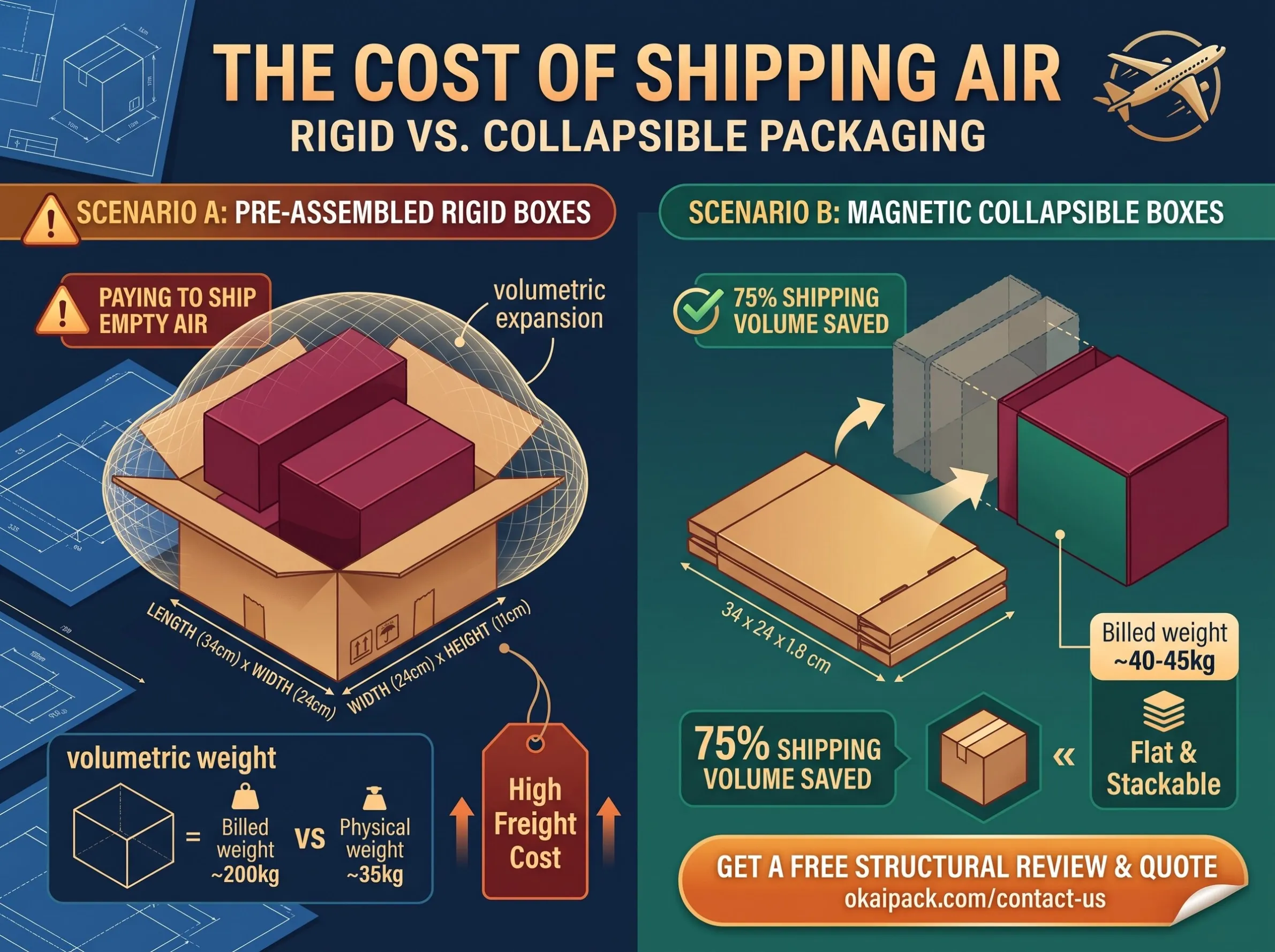
However, in international commerce, an overlooked physical reality often derails launching brands: freight is not charged on what a box weighs, but on how much empty air it encloses.
Without structural optimization, it is common for a newly developed rigid box to incur door-to-door air courier costs that exceed the actual manufacturing invoice. Understanding two core engineering principles—volumetric freight math and hardware assembly economics—is essential before sending CAD renders into production.
1. The Volumetric Weight Formula: Paying to Ship "Empty Space"
Global air express carriers (such as DHL, FedEx, and UPS) utilize a universal billing formula called Dimensional Weight (Volumetric Weight) to charge for aircraft cabin volume:
International carriers compare physical gross weight against volumetric weight and bill according to whichever figure is higher.
The Real-World Math: 100 Assembled Rigid Boxes vs. 100 Collapsible Boxes
Once delivered, high-grade collapsible boxes assemble into a rigid, luxury gift box in seconds using pre-applied 3M heavy-duty industrial corner adhesives and embedded neodymium magnets.
2. External Hardware Latches: The Micro-Run Engineering Paradox
Another common miscalculation among emerging brands is attempting complex exterior hardware (such as custom metal slider buckles, rivets, and fabric straps) on micro-runs of 50 to 100 sets.
While visually striking in 3D mockups, integrating metal and textiles onto rigid board involves three industrial constraints:
- Dedicated Die-Casting Tooling: Custom branded metal buckles require zinc alloy molds. Spreading mold setup charges over only 100 units severely inflates per-unit packaging cost.
- Tolerance and Assembly Drift: In large-scale manufacturing (1,000+ units), custom assembly jigs align hardware and textile straps with sub-millimeter precision. On a 100-piece run, straps must be glued and stitched manually. Hand-assembly inevitably introduces tension variations, causing magnetic closures or latches to sit crooked or fail to snap flush.
- Packaging Obstruction: Protruding exterior metal hardware prevents the rigid board from folding flat, locking the box into the expensive "Scenario A" freight trap mentioned above.
3. Structural Best Practices for Independent Brand Launches
To balance bespoke visual prestige with commercial sustainability, experienced packaging engineers recommend following these structural rules for debut collections:
- Decouple Hardware from Box Enclosures: If signature metal or textile details are central to your collection, integrate them into interior ribbons, pull-tabs, or custom fabric dust pouches rather than the rigid outer box chassis.
- Adopt Proven Structural Foundations: Collapsible magnetic boxes, drawer (sliding) boxes, and two-piece shoulder neck boxes offer structural rigidity while optimizing pallet density.
- Elevate Through Surface Craft: Direct your customization budget into tactile paper stocks, precision hot-foil stamping, spot UV embossing, and custom Pantone flood coats. These treatments add immense luxury feel without altering box mechanics or inflating shipping volume.
Work With Packaging Engineers Who Protect Your Margins
Successful packaging development is not simply about printing an attractive graphic; it is about ensuring that a design is industrially viable, structurally protective, and economically sound to ship across borders.
At OKAI PACK, we evaluate every structural concept through the lens of production reality and international logistics, ensuring your brand makes an unforgettable impression without paying for empty air.